Pages

May 22, 2010


Mom (o)


The craving for Momo is increasing by leaps and bounds. Craving for a food, she didn’t touch for 15 years after that fateful day. She used to feel a strong resentment towards Momo. She often thought the food as the reason for her tragedy. And therefore she kept herself away from it. But now suddenly she is feeling the strongest urge to have it. Initially she tried to fend off the craving, but it slowly overwhelmed her. Throughout the day she was only thinking of Momos.
Then one day she thought of ordering Momos from the nearest Tibetan delight. She picked up the phone and dialled the number but the repulsion crept back and she kept the phone.
More than anything she was scared of her father’s prying. Ever since that incidence she deliberately abstained from Momo, and her father always felt her abstinence illogical. No doubt her father would be happy to see his daughter forgetting the past, but she was too embarrassed to answer any of his questions.
Finally she abandoned the idea of buying it and decided to secretly prepare it at home when the others would be away. The very next day she clandestinely went to the nearby mall and bought all the ingredients. She kept them in the freezer behind other stuff, safeguarding them from peeping eyes.
Throughout the night she was unable to sleep. She was having a strange feeling. She was feeling guilty although she had no reason to feel so, but still she felt culpability. For the last 15 years she had always held this particular food responsible for her misfortune and now all of a sudden she was dying to have it. Throughout the night she felt uneasy and memories of that unfortunate day came back like a movie flashback.

She could see and feel that fateful morning when her mother was preparing ingredients for Momo. It was she who had requested her mom to prepare Momo. From early morning her mom started chopping onions and garlic, kneading the dough, making small balls. She was served steaming hot Momos before she left for school.
Her mom promised Thukpa and Momo after she returned from school.
Even in school she was not able to concentrate. Her mind was only thinking of Momo and Thukpa. Just after the English period she was excitedly discussing the prospect of having momo after school with her friends, when the school office bearer came and asked her to come along to the Princapal’s room. She was surprised with this sudden summon and also scared. Even after thinking a lot she was not able to think of any recent misdeed that could lead her to the Principal’s room. She silently and anxiously followed the bearer.
After entering the principal’s room she was surprised to find her neighbour Mr.Tandon sitting in front of her Principal. Immediately she thought that this man has come to complain about her to the principal. She recollected that the previous week she had not taken Mr.Tandon’s daughter in the game of “chor police”. May be that has irked this man, and he has come to complain.
After she entered the room her principal called her and held her hand very politely, she saw no anger in the principal’s face. He very politely asked her to go home along with Mr.Tandon. She was surprised. Why was she being asked to go home? For a moment she thought maybe her mom wanted her to have the Momo right then. Maybe her mom was as excited as her and couldn’t wait to serve her.
With great anticipation she started for home. When she entered her home’s lawn she saw almost all her neighbourhood people waiting. She was surprised and thought that maybe her mom has called all of them to have Momos.
Mrs Tobden, came and hugged her. She was taken inside. Mrs Tobden was walking very slowly and carefully as if not to disturb anybody.
Slowly they entered her parent’s bedroom; she saw her mother lying on the bed. A plateful of momo was getting cold in the side table. She wondered why her mother was sleeping when there was houseful of guests. That was the day she last had Momo.

15 years later, today she is going to have it once again. Throughout the day when her husband and father were away she made the Momos. In the evening she sat in her veranda and had the first bite of Momo after 15 years, and with the first bite she felt her baby kicking inside her. She became sure that it is going to be a girl. She now knew that her mother is coming back. Her mother was signalling her to get back to her favourite food and not blame it.


Recipe for Momo

Ingredients for Momo
250 grams minced chicken/mutton
2 cusp flour
2 onions chopped
2 cloves garlic chopped
4 green chillies chopped
1 inch ginger chopped
2 shallots chopped
Coriander leaves
1 tsp soya sauce
¼ tsp vinegar
2 lemon juice
2 tsp pepper
Salt to taste

Ingredients for the chutney
2 tomatoes chopped
2 cloves garlic chopped
1 inch ginger chopped
4 red chillies
1 tsp olive oil

How to prepare Momo

Marinate the chicken with lemon juice and vinegar and refrigerate overnight. Take the marinated chicken and add chopped onions, garlic, ginger, shallots, chillies and coriander leaves to it. Mix thoroughly and add salt, pepper and soya sauce. Keep the filling aside.
Take flour in a bowl and add salt to it. Add water and knead into dough. Make small balls from the dough. Roll the balls into small round and put 1 tsp of filling in the middle. Fold the round into a semi circular shape and seal it. Steam it for about 20 minutes.

How to prepare the chutney

Put tomato, garlic, ginger and red chillies in mixer and blend it into a fine paste. Pour olive oil in a pan. Pour the paste into the pan, add salt. Simmer the paste for sometime. Serve the Momos along with this chutney.


Spending a considerable part of my childhood in Gangtok I naturally developed a liking for Tibetan food although, I never tried preparing them at home. This food fiction encouraged me to prepare momo for the first time at home. With all humility I admit it tasted awesome. This is my entry for the second edition of Chalks and Chopsticks hosted by Bong Mom. The first edition of chalks and chopsticks was hosted by Aqua.

May 18, 2010

Creative recession

I believe I am going through a creative recession. For the last 2 weeks I am trying to write a story for the second edition of Chalks and Chopsticks but not being able to do so. Lat time when Aqua held the event I wrote it almost in a day's time. What is happening to me this time?

Kolkata-The city of warmth


I received a forwarded mail today, and i must confess it brought tears to my "probasi"eyes. Ever since I left Calcutta, missing my city has become a daily ritual. Therefore today these words of kindness for my city really moved me.

I am copy pasting the mail.(as it is a forwarded mail, i hope there is no copyright issue)


Most modern Indian cities strive to rise above ethnicity. Tell anybody who
lives in Bombay that he lives in a Maharashtrian city and (unless of course,
you are speaking to Bal Thackeray) he will take immediate offence. We are
cosmopolitan, he will say indigenously. Tell a Delhiwalla that his is a
Punjabi city (which, in many ways, it is) and he will respond with much
self-righteous nonsense about being the nation's capital, about the
international composition of the city's elite etc. And tell a Bangalorean
that he lives in a Kannadiga city and you'll get lots of techno-gaff about
the internet revolution and about how Bangalore is even more cosmopolitan
than Bombay.

But, the only way to understand what Calcutta is about, is to recognize that
the city is essentially Bengali. What's more, no Bengali minds you saying
that. Rather, he is proud of the fact. Calcutta's strengths and weaknesses
mirror those of the Bengali character. It has the drawbacks: the sudden
passions, the cheerful chaos, the utter contempt for mere commerce, the
fiery response to the smallest provocation. And it has the strengths
(actually, I think of the drawbacks as strengths in their own way). Calcutta
embodies the Bengali love of culture; the triumph of intellectualism over
greed; the complete transparency of all emotions, the disdain with which
hypocrisy and insincerity are treated; the warmth of genuine humanity; and
the supremacy of emotion over all other aspects of human existence.

That's why Calcutta is not for everyone. You want your cities clean and
green; stick to Delhi. You want your cities, rich and impersonal, go to
Bombay. You want them high-tech and full of draught beer, Bangalore's your
place. But if you want a city with a soul, come to Calcutta.
When I look back on the years I've spent in Calcutta - and I come back so
many times each year that I often feel I've never been away - I don't
remember the things that people remember about cities. When I think of
London, I think of the vast open spaces of Hyde Park. When I think of New
York, I think of the frenzy of Times Square. When I think of Tokyo, I think
of the bright lights of Shinjiku. And when I think of Paris, I think of the
Champs Elysee. But when I think of Calcutta, I never think of any one place.
I don't focus on the greenery of the maidan, the beauty of the Victoria
Memorial, the bustle of Burra Bazar or the splendour of the new Howrah
'Bridge'. I think of people. Because, finally, a city is more than bricks
and mortars, street lights and tarred roads. A city is the sum of its
people. And who can ever forget -or replicate - the people of Calcutta?

When I first came to live here, I was told that the city would grow on me.
What nobody told me was that the city would change my life. It was in
Calcutta that I learnt about true warmth; about simple human decency; about
love and friendship; about emotions and caring; about truth and honesty. I
learnt other things too. Coming from Bombay as I did, it was a revelation to
live in a city where people judged each other on the things that really
mattered; where they recognized that being rich did not make you a better
person - in fact, it might have the opposite effect. I learnt also that if
life is about more than just money, it is about the things that other cities
ignore; about culture, about ideas, about art, and about passion. In Bombay,
a man with a relatively low income will salt some of it away for the day
when he gets a stock market tip. In Calcutta, a man with exactly the same
income will not know the difference between a debenture and a dividend. But
he will spend his money on the things that matter. Each morning, he will
read at least two newspapers and develop sharply etched views on the state
of the world. Each evening, there will be fresh (ideally, fresh-water or
river) fish on his table. His children will be encouraged to learn to dance
or sing. His family will appreciate the power of poetry. And for him,
religion and culture will be in inextricably bound together.

Ah religion! Tell outsiders about the importance of Puja in Calcutta and
they'll scoff. Don't be silly, they'll say. Puja is a religious festival.
And Bengal has voted for the CPM since 1977. How can godless Bengal be so
hung up on a religions festival? I never know how to explain them that to a
Bengali, religion consists of much more than shouting Jai Shri Ram or
pulling down somebody's mosque. It has little to do with meaningless ritual
orsinister political activity.The essence of Puja is that all the passions
of Bengal converge: emotion, culture, the love of life, the warmth of being
together, the joy of celebration, the pride inartistic ex-pression and yes,
the cult of the goddess.

It may be about religion. But is about much more than just worship. In which
other part of India would small, not particularly well-off localities, vie
with each other to produce the best pandals? Where else could puja pandals
go beyond religion to draw inspiration from everything else? In the years I
lived in Calcutta, the pandals featured Amitabh Bachchan, Princes Diana and
even Saddam Hussain! Where else would children cry with the sheer emotional
power of Dashimi, upset that the Goddess had left their homes? Where else
would the whole city gooseflesh when the dhakis first begin to beat their
drums? Which other Indian festival - in any part of the country - is so much
about food, about going from one roadside stall to another, following your
nose as it trails the smells of cooking?

To understand Puja, you must understand Calcutta. And to understand Calcutta
, you must understand the Bengali. It's not easy. Certainly, you can't do it
till you come and live here, till you let Calcutta suffuse your being,
invade your bloodstream and steal your soul. But once you have, you'll love
Calcutta forever. Wherever you go,a bit of Calcutta will go with you. I
know, because it's happened to me. And every Puja, I am overcome by the
magic of Bengal. It's a feeling that'll never go away.

May 16, 2010

Fuchka

fuchka@prathampadokhep.blogspot.com

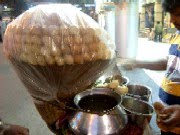
One food I absolutely love is Fuchka. Therefore after leaving Kolkata, the first thing that I started missing was fuchka. My life became dull and depressed without the presence of fuchka. My evenings were no more spicy and hot. At times I felt so desperate for fuchka that I used to think of paying a two day visit to Kolkata only to have fuchka.
Pani puri is definitely a dish from the fuchka family, but the similarities are as same as between Nirupa Roy and Rakhi Sawant. Therefore my taste buds were never satisfied with the sweet pani puri and craved for the hot and spicy version. Initially I felt a total repulsion towards pani puri, but slowly I started giving it some benefit of doubt. Still it was not able to conquer me the way fuchka did. I often used to direct the panipuriwalla to make it like puchka. In most cases I became the butt of ridicule.
Finally my hard days came to an end. Last week I had fuchka here in the city of hopes itself. Thanks to hanglas for importing a fuchkawala from Kolkata. This man has brought relief to troubled and starved souls like us. I almost felt orgasm after having the first bite of Kolkata’s fuchka after three long years. May this man not face the wrath of Raj Thackeray. Amen.

May 14, 2010

Aamsutra part II

After the "aamras" it was time for the pora amm er sharbat. My only objective in life was to get rid of the crate of mangoes.
As they say every food item has a story to tell. Pora amm er sharbat reminds me of Prof Ratnabali Chatterjee. She was my guide when I was doing my M.phil term paper. Often she used to call me at her residence to discuss the paper. One such sultry afternoon when I reached her home, she served me a cold glass of Aampora sherbat. She prepared it herself. Ever since whenever I hear Aampora sherbat, that afternoon comes to my mind.Nothing is more soothing than this in a hot summer afternoon.


Ingredients

4 Raw green mango
200 grams Sugar
1/2 teaspoon Rock Salt
1/2 teaspoon Red Chilli flakes
1 teaspoons Roasted and ground Cumin powder

Preparation

Roast the mangoes in their jackets over a flame.
Cool the mangoes and then remove the skin.
Scoop out the pulp and mash it after removing the seed
Pass the pulp through a sieve, so that the fibres, if any, are removed.
Add powdered sugar, chilli, flakes, rock salt and mix over medium flame for a minute or two.
Sprinkle roasted and ground cumin powder.
Take it off the flame. Cool and store the concentrate in glass bottles.
To make a drink, add 1/4 glass of the concentrate. Add ice cubes and chilled water.

Kumror Chakka

My mother was a great cook (I know, I know, all of us think that our mothers are great cooks). She had the competence of turning mundane items into tasty delights. Unfortunately I am not a good cook and unlike her I often turn expensive rare items into gourmet nightmare. Therefore I think the gene factor is not really working.
My mother had a habit of never throwing away anything. This had its adverse effect as our house was always overburdened with old clothes, furniture, old souvenirs and toys. Nevertheless, when it came to cooking this habit mostly bore fruitful results. She used to fry the skin of potato or gourd and turn them into crispy fryums. She used to paste the skin of raw banana along with mustard and poppy seed and prepared a concoction that tasted awesome with steamed rice.
One of her dishes that were very simple but tasty was Kumror chakka. Pumpkin is not my favourite vegetable infact I wonder if it is anybody’s favourite, but this dish I simply loved. After my marriage even my husband seems to love it. I do not prepare it much often, occasionally when I do prepare I try to put my entire heart and soul. It is my tribute to my mother. My mother always panicked that I will never be able to cook anything (forget being a good one). She often expressed sorrow for the guy who would marry me as she wondered that the poor chap would stay unfed and uncared. Therefore today when I am able to prepare one of her dishes efficiently I feel happy and content that at least my mother’s soul is resting in peace that her daughter has finally become a cook.

To prepare this recipe you need Pumpkin and Pumpkin and Pumpkin.

500 gms Pumpkin
100 gms Chola(soaked overnight and boiled)
3 tbsp Cumin seeds
2 Red Chillies
2 Grenn chillies
1 tsp Turmeric powder
Mustard oil
Salt to taste

Cut the pumpkin into small pieces. Roast 2 tbsp cumin seed and 2 red chillies and dry grind them into a fine powder. Keep aside.
Heat oil in a pan
Add remaining cumin seeds and green chillies.
When the seeds start spluttering add the pumpkin
Sauté for some time let it turn brown
Add turmeric and salt
Cover the pan and cook in medium heat
Once the pumpkin is soft and mushy add the chola
Cook for some time
Add the roasted cumin and chilli powder
Cook for some more time


Serve with hot rotis.Alternately you can also serve them with luchis. I remember my mother used to serve it with triangular paranthas or parotas (as we Bengalis pronounce them).

May 13, 2010

Aamsutra

My next door flat is always rented out to queer people. Earlier a young girl stayed who used to feel ghosts in the night. One night at around 3:30 am she texted me that there was a ghost in her room and she was not able to sleep. Slowly in a months time the ghost scare turned her insomniac and even before the lease license for her flat was over she decided to leave.
A young obese man with a boyish face, in his late twenties, occupied the flat soon after. From the first day of his occupancy I became the official keeper of his duplicate flat keys. Every alternate day I get a call from this guy which inevitably says “Bhabiji, sorry to disturb you, but I have forgot my laptop charger at home, could you please open my flat door and collect it and send it, I am sending someone to get it”. The laptop charger is on different occasion replaced by palm top, folder, USB drive, sunglasses and so on and so forth. Every time, I have to open his flat and search for the things in his highly messed up bachelor’s flat. I am not complaining about this fellow because I kind of like him. His forgetful nature amuses me more than irritates. At times he gives me a call and asks me to handover the keys to his friend who came over to stay with him for a couple of days.
Now last week one of his friends came to stay with him- incidentally this guy also collected the keys from me-who brought along with two crates of farm fresh mangoes.
Now these two guys were unable to decide the fate of the mangoes, so eventually the poor fruits landed at my place. It was also my neighbour’s way of returning favours. Incidentally these mangoes instead of amusing me burdened me whatsoever. What am I supposed to do with two crates of mangoes?
My neighbour promised me that he would help me finish off the mangoes. But, the very next day he left to the US for two whole weeks. I don’t know if it was deliberate to escape from the mango overdoing.
Now I am left with two crates of mangoes and only two souls to finish them. The mangoes are ripe and if not eaten now they will perish in a couple of days. My house is now invaded by yellow sweet things. I have now started using them in every possible way. My maid suggested that the easiest way to get rid of bulk mangoes is “aamras”. So off I go.


Ingredients
Ripe mangoes 5 -6
Milk 2 cups
Sugar 50 gms
Ice cubes

I first peeled the mangoes and cut them into small pieces. Then I put them in a blender along with milk and sugar. After it turned smooth I added ice cubes and served. Alternatively you can also put it in the refrigerator for some time and then serve chilled. Nothing is more soothing than Aamras in a hot summer afternoon.

LinkWithin

Related Posts with Thumbnails